

The school organized the Money or Life program for these seventh-graders. The purpose of today’s session is for the pupils to understand what financial responsibility is and to learn how to apply it in their lives—a very valuable skill as they grow into adulthood. See how the program unfolded.
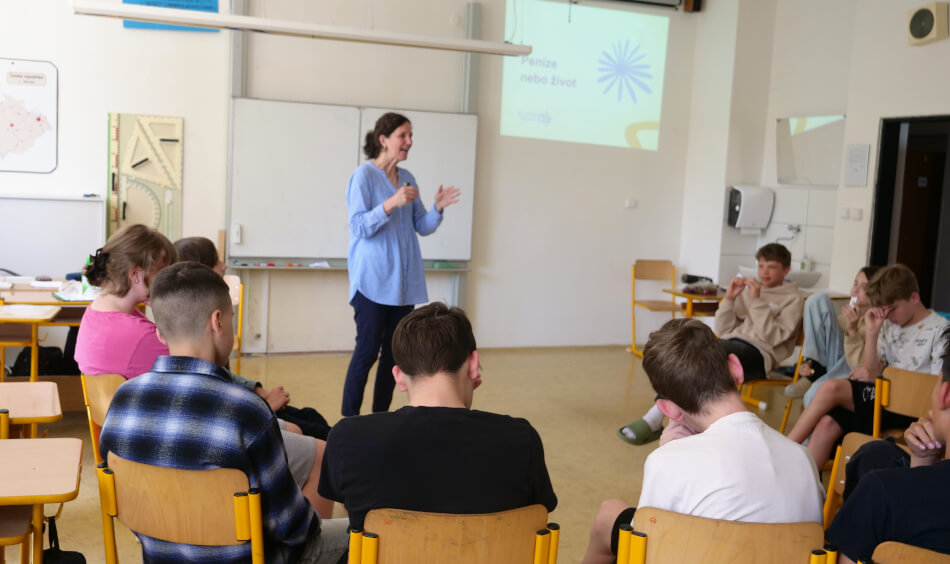
It’s important to start with a brief introduction—both of the topic and the HY worker. This way, the children know what to expect during today’s three-hour-program.
Today, seventh-graders will take part in a three-hour experiential program called Money or Life. The goal is to open the door to the world of financial literacy and responsibility for these teenagers.
It’s clear that we don’t learn any skill in life right away; everything requires gradual practice, gathering information, and overcoming numerous obstacles. This program is absolutely ideal for that and perfectly suited to the participants’ age.
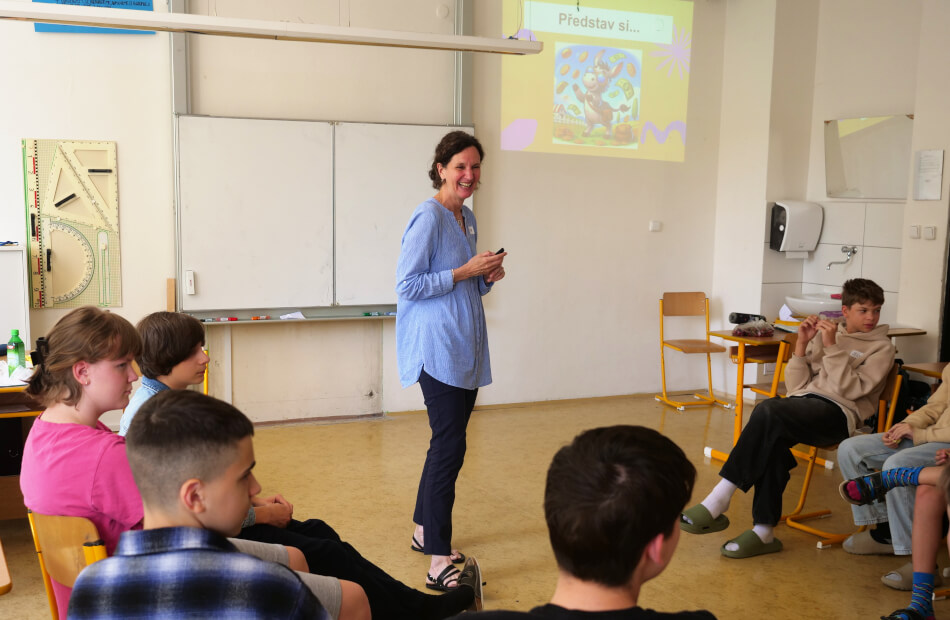
A warm-up question to start with: “Imagine you have a fairy-tale donkey that shakes itself and brings you an unlimited amount of money. What would you buy?”
After introducing the program and the rules for the meeting, Petra lets the pupils daydream a little with their eyes closed: “Imagine you have a fairy-tale donkey that shakes itself and brings you an unlimited amount of money. What would you buy?”
The question seems simple, but even at this moment, the hidden thought processes of many teenagers become apparent: How will they answer? Will they stick to something realistic, or will they let their imaginations run wild? Will they come up with provocative nonsense, or will they take this challenge seriously? Will they even dare to say out loud what came to mind, or will their inner self-censorship generate an answer that conforms to what others might say?
The personality of each listener is already revealed here.
Next comes a segment explaining basic terms such as: interest, rate, bank fees, and so on. I like that Petra doesn’t explain everything right away, but instead asks the listeners what they know about the topic and then uses their own layman’s terms to explain the reality to them in a way that’s as close as possible to their own language.
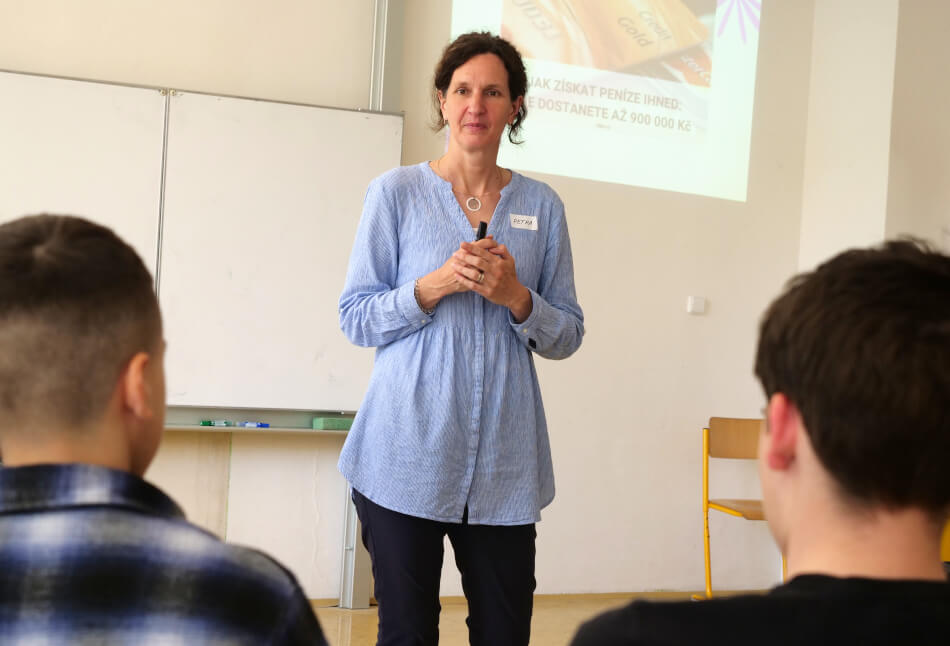
Payday loans sound very tempting, but… Petra is discussing the pitfalls of money obtained this way with the children.
Next comes a very practical story through which Petra gradually explains what might happen to the pupils and how to respond to real-life situations involving financial responsibility.
In the story, two young people start dating, move in together in a rental apartment, and the young man subsequently crashes his car. He asks the girl to take out a loan in her name, using familiar manipulative phrases like, “If you care about me…” and the girl actually takes out the loan herself.
After some time, the couple breaks up, and the girl discovers that the boy isn’t making the loan payments. It’s a sad situation, but by no means unusual.
As the story unfolds, pupils learn to understand the mechanisms at work in both relationships and finance. When I see the engagement of most seventh-graders and their sincere search for answers, it’s clear to me that the program is definitely having an impact.

Nothing beats concrete examples. The children are trying to draw up a budget for a typical family of four.
In the next part of the program, Petra once again explains to the pupils the concepts they’ll encounter in their daily lives when it comes to money, and they also come across a fundamental question: “Can a child go into debt?” The answer isn’t simple or universal, so Petra gradually explains when it’s possible and when it isn’t.
When, toward the end of the program, the pupils are given a group assignment to create a budget for a family of four—where they fill in individual items ranging from rent to food and children’s extracurricular activities, and must correctly estimate their costs—it strikes me as very practical and useful for real life.
I’m not at all surprised that, in the final reflection, both the pupils and the teacher spoke very highly of the program. For many participants, programs like this can help save them from a lot of headaches down the road. I wish something like this had been available sooner!
Martin Stavjanik, the Authorized Supervisor of the HY Program workers